HMIS in Modern Healthcare: How Hospedien Moves Beyond Basic Digitization
04 May 2026 | Expedien
Understanding HMIS as a Technology
A Hospital Management Information System is not just a digital record keeping tool. It is a connected technology framework that brings clinical, administrative, and operational functions into one environment. HMIS works through a centralized data architecture. Every action within a hospital creates data like Patient registration, Consultations, Lab reports, Billing, Pharmacy transactions. HMIS connects them in real time.
Information flows across departments without repetition.
Updates made in one place reflect everywhere else.
The system becomes a single source of truth.
Modern HMIS platforms are also built to be scalable. They support multiple users, departments, and even locations while maintaining efficiency. Integration capabilities allow them to connect with diagnostic devices, insurance systems, and external platforms.
ABDM M1, M2, M3 Certified HMIS for India’s Digital Health Ecosystem
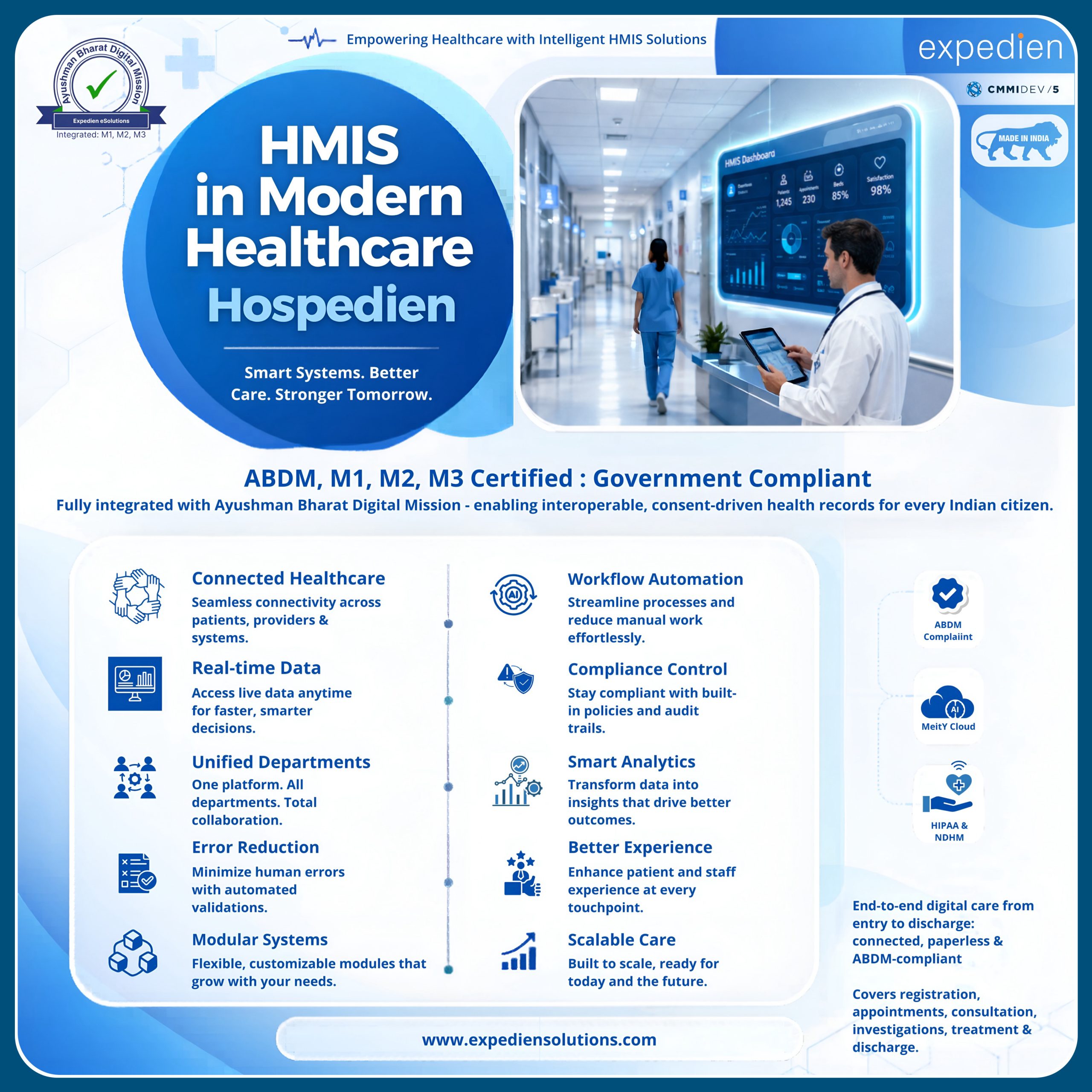
Hospedien by Expedien eSolutions is a fully ABDM-aligned Hospital Management Information System designed to bring hospitals onto India’s national digital health framework. The platform enables interoperable, consent-driven health records while ensuring compliance with the Ayushman Bharat Digital Mission with M1, M2, and M3 certifications.
Hospitals can securely exchange patient data across providers, labs, and pharmacies through the national health network. Patients remain in control of their data through consent-based sharing, while hospitals benefit from government incentives, ABDM directory listing, and compliance recognition. Standardized digital records also accelerate PM-JAY and TPA claim processing, reducing delays and paperwork.
Smarter Hospitals with Unified Digital Workflows
Hospedien is built as an AI and blockchain enabled platform that connects every department and every workflow into one system. The focus is simple: Create a hospital environment that is efficient, paperless & accurate.
The system delivers 99.9 percent uptime, reduces paperwork by up to 70 percent, and ensures complete data accuracy with more than 20 integrated modules. Every function operates within a connected framework instead of isolated systems.
The platform supports end to end digital care from the moment a patient enters the hospital to final discharge. Every step is structured and recorded.
Registration includes automatic UHID creation and ABHA linking. Appointments can be booked online or at the counter. Consultations generate digital prescriptions and diagnoses. Lab and radiology investigations are directly integrated. Treatment workflows track drugs, IVs, and bed allocation. Discharge summaries are auto generated with complete accuracy.
This continuous flow ensures that no part of the patient journey remains disconnected.
Comprehensive Modules Covering Every Hospital Function
Hospedien brings together all hospital operations within a single platform.
OPD management handles registration, appointments, and smart queue systems.
IPD management supports admissions, bed allocation, ward transfers, nursing workflows, and discharge.
Doctor prescription modules include ICD-10 coding, treatment plans, and full access to patient history.
OT management supports surgical scheduling, team coordination, and pre and post-operative documentation.
Pharmacy systems manage dispensing, stock control, expiry tracking, and drug interaction alerts.
Pathology and lab modules enable sample tracking, result entry, and automated patient notifications.
Radiology includes equipment scheduling, DICOM viewer, and report management. Billing and accounts cover OPD, IPD, surgical billing, TPA claims, financial reporting, and reconciliation.
Inventory modules track stock, suppliers, purchase orders, and GRN processes.
Drug and IV management ensure proper scheduling and Bed Head Ticket tracking.
Blood bank and HR payroll modules further complete the operational ecosystem.
Everything works within one connected system reduces duplication and improving coordination.
Built for Modern Healthcare Experience and Compliance
Hospedien is designed to improve both patient experience and operational efficiency.
Patients can access services through a mobile app for appointments, lab reports, teleconsultation, and prescriptions.
AI powered chatbots handle queries round the clock and reduce staff workload.
IVR voice booking improves accessibility for a wider audience.
The platform supports real time analytics, MIS reporting, and business intelligence for better decision making.
Multi channel alerts and role based access ensure smooth communication and secure usage.
Hospedien meets all major regulatory requirements. It supports ABDM interoperability, follows HL7 and FHIR standards for data exchange, and aligns with HIPAA and NDHM for data privacy.
It is NABH ready, helping hospitals move toward accreditation faster. The system is hosted on MeitY certified cloud infrastructure which ensures reliability and government approved standards.
Continuous Support and Future Ready Innovation
Hospedien is supported by a dedicated ecosystem that ensures long term reliability and growth.
A 24 by 7 helpdesk provides assistance through phone, email, and chat with defined response timelines.
Regular maintenance includes system health checks, security updates, bug fixes, and ABDM API upgrades with minimal downtime.
Hospitals can customize workflows, add new modules, integrate third party systems, and adapt the platform to their needs.
Training is delivered through a cloud based learning system with role specific tutorials and live sessions.
Expedien eSolutions shall continue to enhance the platform with AI driven capabilities, stronger data security through blockchain, and scalable cloud infrastructure. The system is designed to evolve with changing healthcare requirements and national digital initiatives.
Hospedien brings together compliance, technology, and usability into one structured platform, helping hospitals transition into fully digital, connected, and patient centric environments while staying aligned with the future of healthcare in India.
Why HMIS Becomes Essential
Manual processes or partially digital systems often create gaps. Healthcare environments are time sensitive. Delays or errors can affect outcomes directly.
HMIS addresses this by structuring workflows. Each process follows a defined path. From admission to discharge, every step is recorded and traceable.
Accuracy improves because data is entered once and used across the system. Redundancy is reduced.
Communication between departments becomes faster because everyone accesses the same information.
Another important aspect is compliance. Healthcare requires strict documentation and data handling standards. HMIS helps maintain these standards consistently.
Utility Across Hospital Functions
The impact of HMIS can be seen across daily hospital operations.
In patient management: Registration becomes faster and more structured. Unique records are created and maintained without duplication.
In clinical workflows: Doctors can access patient history, prescriptions, and diagnostic reports instantly. This supports better decision making.
In diagnostics: Lab and radiology departments can update reports directly into the system. Results are available without delays or manual transfers.
In billing and finance: Transactions are recorded in real time. Insurance processing becomes smoother because all required data is available in one place.
In pharmacy management: Inventory is tracked continuously. Stock levels are visible which reduces shortages and wastage.
HMIS also supports reporting and analytics. Management can view performance metrics, patient flow, and operational efficiency without relying on manual reports.
Benefitting all Stakeholders
Each stakeholder interacts with HMIS differently but benefits from the same connected system.
Doctors gain clarity. They spend less time searching for information and more time focusing on treatment. Access to complete patient data improves clinical decisions.
Nursing staff experience smoother coordination. Instructions, updates, and records are available without confusion.
Administrative teams gain control over operations. Scheduling, billing, and resource allocation become easier to manage.
Hospital management gains visibility. They can monitor performance, identify bottlenecks, and plan improvements based on actual data.
Patients experience faster services. Waiting times reduce. Processes feel more organized. Communication becomes clearer.
Insurance providers and external partners also benefit. Data sharing becomes structured which reduces delays in approvals and processing.
How Hospedien Aligns with Real Hospital Environments
Hospedien by Expedien eSolutions is designed with a strong focus on real operational needs.
The platform is structured around existing workflows. Departments remain connected without losing their individual processes.
The system is modular. Hospitals can adopt features based on their requirements and expand gradually. This reduces disruption during implementation.
Integration is a key focus. Hospedien connects with diagnostic systems, billing processes, and other external platforms to maintain continuity.
User experience is kept simple so that staff across different roles can adopt it easily. This improves usage and ensures that the system delivers consistent value.
Keeping Pace with Innovation
Expedien keeps Hospedien aligned with the ever-evolving dynamics of the Healthcare technology. It continues enhancing its capabilities to support scalability so that hospitals can grow without needing to replace their technology.
Automation is gradually introduced to reduce manual effort.
Reporting tools are improved to provide clearer insights.
Security measures are updated to handle increasing data sensitivity.
Cloud scalability continues to be efficient as it’s crucial for recording patient data.
Hospedien is built to operate in environments that support remote access and centralized management, making it adaptable for multi-location healthcare providers.
Hospedien reflects this approach by focusing on practical functionality, adaptability, and continuous improvement. The goal is not just to introduce technology but to make healthcare operations more reliable and easier to manage every day. It improves efficiency, reduces errors, and enhances patient experience without adding complexity.
Long Term Operational Stability
Technology decisions in healthcare are long term. Hospitals cannot afford to change systems frequently. Expedien ensures seamless support & frequent upgrades aligning with the healthcare dynamics.
A well implemented HMIS provides stability over years of operation. Processes become standardized. Staff become familiar with workflows. Data accumulates in a structured manner.
Hospedien supports this stability by allowing gradual improvements instead of sudden changes. Updates can be introduced without disrupting daily work.
This approach ensures that the system grows with the hospital rather than becoming a limitation over time.