e-Governance Driving Digital Transformation in Higher Education
30 July 2025 | Expedien
Why e-Governance Came into Existence – The Utility
The higher education sector in India is experiencing a phase of rapid transformation. Regulatory frameworks such as NEP 2020, NAAC, NIRF, AICTE and UGC are pushing universities to adopt higher benchmarks for quality, governance and data transparency. Many institutions are managing larger student populations and expanding across multiple campuses and digital platforms. These changes have made it necessary for universities to move away from manual, fragmented systems and adopt a unified digital governance framework.
Reinventing the Higher Education in India: The Role of e-Governance and AI in University Transformation
Indian universities are at a turning point where the push for digital transformation, national educational reforms, global academic competitiveness and rising student expectations necessitates a radical shift from traditional methods to intelligent and integrated systems. The inception of University e-Governance came into existence for facilitating the ever-growing administration needs of the academic sector. In today’s time, the e-Governance systems are more robust than ever as they are now being powered by AI which offers smart, scalable solutions to the future-ready institutions.
Why Indian Universities Need e-Governance1. Student Expectations
Today’s students expect real-time access to academic records, digital communication channels with faculty and seamless access to learning content.
2. Compliance and Accreditation Pressures
Regulatory bodies such as NAAC, NIRF, and UGC require timely data reporting and transparent governance structures. The pressure on institutions has intensified with NEP 2020 which introduced additional requirements. Since the accreditations play a crucial role in governance hence the need for systems that help universities stay audit-ready by automating data collection, streamlining compliance workflows, and generating standardized reports for submissions.
3. Rise in Multi-Campus and Distance Learning Models
Universities are broadening their academic reach by launching distance learning programs and setting up off-campus centres. Effectively managing these geographically dispersed operations demand centralized monitoring and control.
4. Reducing Human Errors and Fraud
Manual administrative processes are often prone to errors, data mismatches, and manipulation risks.
The AI Advantage: Smarter e-Governance for Universities1. Predictive Analytics
As universities grow in scale and complexity, they increasingly require data-driven insights to make informed decisions. From improving student outcomes to optimizing resource allocation, the ability to anticipate trends and challenges is essential.
2. Decision Intelligence for Administration
AI-driven recommendations help in faculty workload distribution, recruitment planning and sentiment analysis based on student feedback. These insights enable data-backed governance decisions.
3. Smart Communication and Engagement
The platform integrates AI chatbots to address student service queries, automate reminders for assignment deadlines, and provide multilingual communication support to cater to diverse student demographics.
How e-Governance is Benefiting All Members of the Academic Ecosystem• Academic Staff
E-Governance in higher education promotes transparency, efficiency, and accountability by digitizing academic operations and minimizing manual intervention. It ensures timely access to data, streamlines communication, and facilitates informed academic decision-making.
• Non-Academic Staff
E-Governance empowers administrative teams by digitizing workflows, reducing paperwork, and improving turnaround times for essential services like HR, finance, and student related requirements. It facilitates operational transparency and data-driven decision-making.
• Students
E-Governance enhances the student experience by offering seamless, transparent, and efficient access to academic and administrative services. It reduces dependency on manual processes, eliminates delays and empowers students to manage their academic journey more independently.
• Parents/Guardians
E-Governance provides transparency and trust by giving parents greater visibility into their child's academic progress and campus life. It enables timely access to important information such as attendance, examination results, fee status, and institutional announcements. This ensures that they stay informed and involved without needing constant manual updates from university staff.
Further Benefits and Long-Term Impact1. Sustainability
E-Governance not only minimizes the environmental footprint but also eliminates the dependency on physical storage infrastructure which lowers the operational costs and promotes eco-friendly campus practices. Additionally, the digital processes enhance data accessibility and security which contributes to a more efficient and responsible institutional environment.
2. Data Security and Auditability
The e-Governance platforms offer role-based user permissions, encryption of sensitive information, and blockchain-ready transcript issuance which ensures secure and tamper-proof academic record management.
3. Global Competitiveness
Universities can reallocate resources toward academic excellence, research and innovation by digitizing routine administrative tasks. This operational efficiency not only frees up time and manpower but also enhances institutional performance which contributes to improved international rankings and opens up greater opportunities for cross-border academic collaborations.
at all levels.
What a Complete University ERP System Can Deliver1.Academic Lifecycle Management
• Admissions: AI-based profiling to suggest best-fit programs and predict dropout risk.
• Course Registration: Automated, rules-based registration aligned with credit requirements.
• Attendance & Evaluation: Integration with biometrics, facial recognition, or QR codes for real-time attendance.
• Exams: Online/offline/hybrid exam platforms with plagiarism detection, OMR, and on-screen evaluation.
• Graduation: Digital degree generation, document verification, and alumni tracking.
2. Administrative & Financial Control
• Fee Management: Dynamic fee structuring, online payments, scholarship processing.
• Payroll & HR: Biometric attendance, automated payslips, and performance analytics.
• Procurement: Digital inventory, tender tracking, and vendor management.
• Hostel/Transport: Room allocation, mess feedback, and vehicle GPS tracking. 3. Regulatory & Governance
• Auto-generated reports for NAAC, AICTE, NBA, AISHE, etc.
• Outcome-based education tracking and student learning analytics. From Legacy to Leadership
Indian universities can no longer afford to rely on outdated and disconnected systems. The need of the hour is a unified, intelligent, scalable, and easy-to-use infrastructure that drives academic excellence, enhances regulatory compliance and improves operational agility. The IUMS Advantage – Powered by Expedien
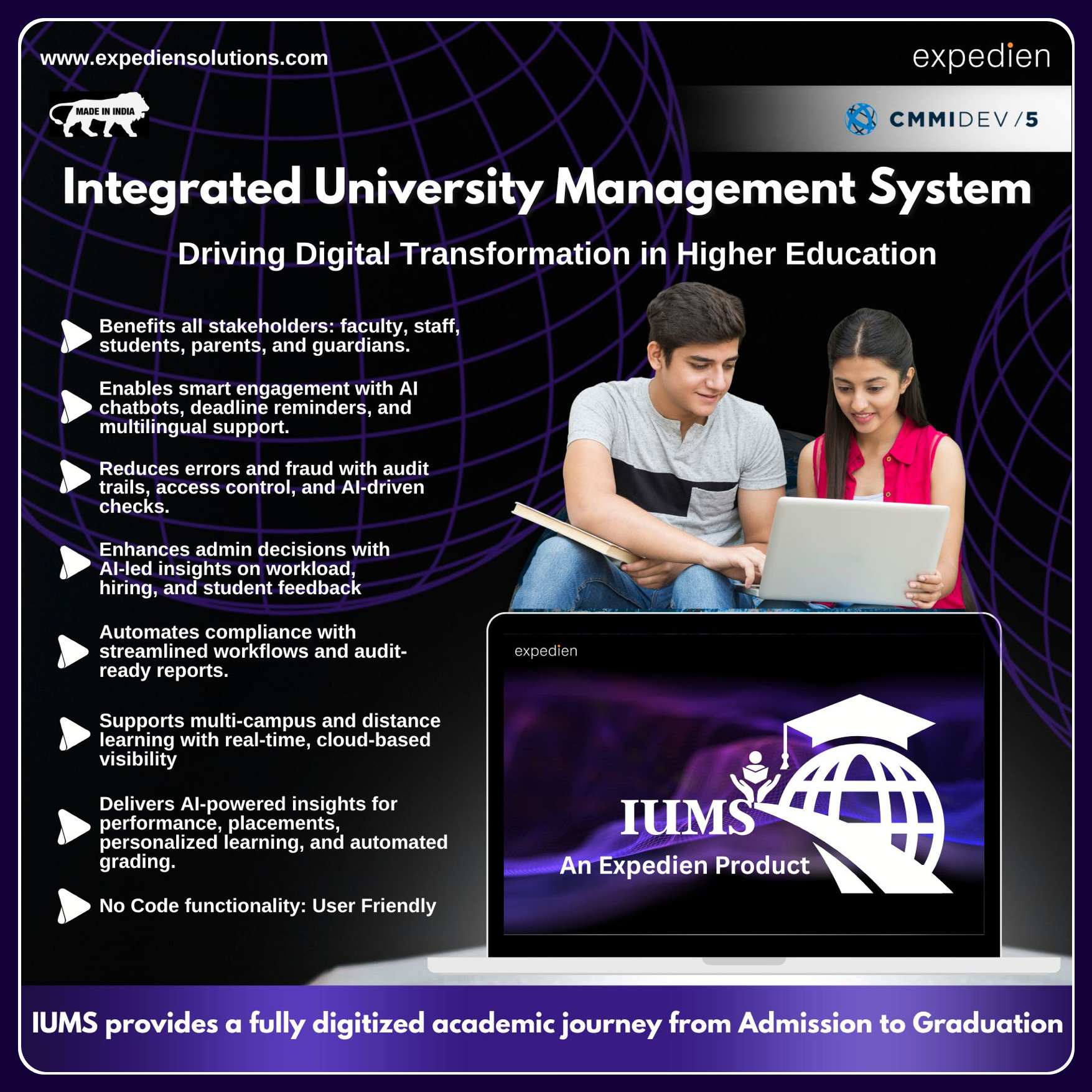
Expedien’s Integrated University Management System (IUMS) is a comprehensive solution designed to meet the evolving academic and administrative challenges faced by the Institutions. IUMS provides a fully digitized student journey from admission to graduation.
• Supports Compliance and Accreditation Pressures
The IUMS accommodates the needs of the Universities by helping them stay audit-ready by automating data collection, streamlining compliance workflows, and generating standardized reports for submissions.
• Manages Multi-Campus and Distance Learning Models
With its cloud-native deployment and scalable dashboards, the IUMS provides real-time visibility across all campuses and learning centres.
• Reduces Human Errors and Fraud
IUMS reduces these errors by introducing digital audit trails, role-based access control and AI-powered anomaly detection tools.
• Delivers AI-Powered Predictive Analytics
The IUMS addresses this need through its AI-integrated tools which enable universities to predict academic performance and analyse placement trends. It offers personalized learning recommendations, chatbot support for academic queries and automated grading systems that reduce faculty workload while enhancing student feedback processes.
• Enhances Decision Intelligence for Administration
AI-driven recommendations in IUMS help in faculty workload distribution, recruitment planning, and sentiment analysis based on student feedback.
• Powers Smart Communication and Engagement
IUMS integrates AI chatbots to address student service queries, automate reminders for assignment deadlines, and provide multilingual communication support.
• Benefits all members of the Academic ecosystem
I. Academic Staff: IUMS enhances the e-Governance framework by automating tasks such as timetable scheduling, attendance tracking, grading, and academic reporting. It also supports curriculum planning and outcome-based education, allowing faculty to focus more on teaching and research.
II. Non-Academic Staff: IUMS facilitates automated leave processing, payroll management, service request handling and document generation. Its user-friendly, low-code/no-code interface enables non-technical staff to manage operations effectively which boosts overall institutional efficiency.
III. Students : IUMS benefits students in multiple ways as it provides a centralized student portal where learners can access real-time updates on attendance, grades, course materials, fee payments, examination schedules and academic progress. Innovative features like AI-powered chatbots, personalized notifications and digital document access streamline communication and ensure that the students stay informed and engaged.
IV. Parents/Guardians: IUMS gives them easy access over the student activity in a transparent way, this connection is established by dedicated portals with real-time performance dashboards, automated alerts, and digital communication channels.
The IUMS supports institutional sustainability goals by facilitating fully paperless operations through the digitization of administrative workflows, academic records, and communication processes by significantly reducing paper consumption and waste. It integrates features within a unified system that provides universities with a reliable and auditable framework for managing institutional data with confidence, ensuring data security and auditability. The IUMS is equipped with globally approved digital infrastructure which enables seamless integration with international academic standards and mobility frameworks.
The IUMS is built on Expedien’s Eintity Enterprise Framework which leverages the power of low-code and no-code tools to transform university governance. It enables administrators and staff to:
• Customize academic and administrative workflows
• Build forms for student services, faculty operations, and approvals
• Generate detailed reports for compliance, audits, and internal reviews
This flexibility ensures that universities can make timely updates to the system, respond swiftly to regulatory or academic changes and operate more independently from specialised IT departments. IUMS enhances the responsiveness and agility of higher education institutions within the e-Governance ecosystem.
IUMS by Expedien offers intuitive interface with AI-driven intelligence and low-code deployment flexibility that helps institutions empower students, faculty and administrators